In Search of the Old Ones by David Roberts
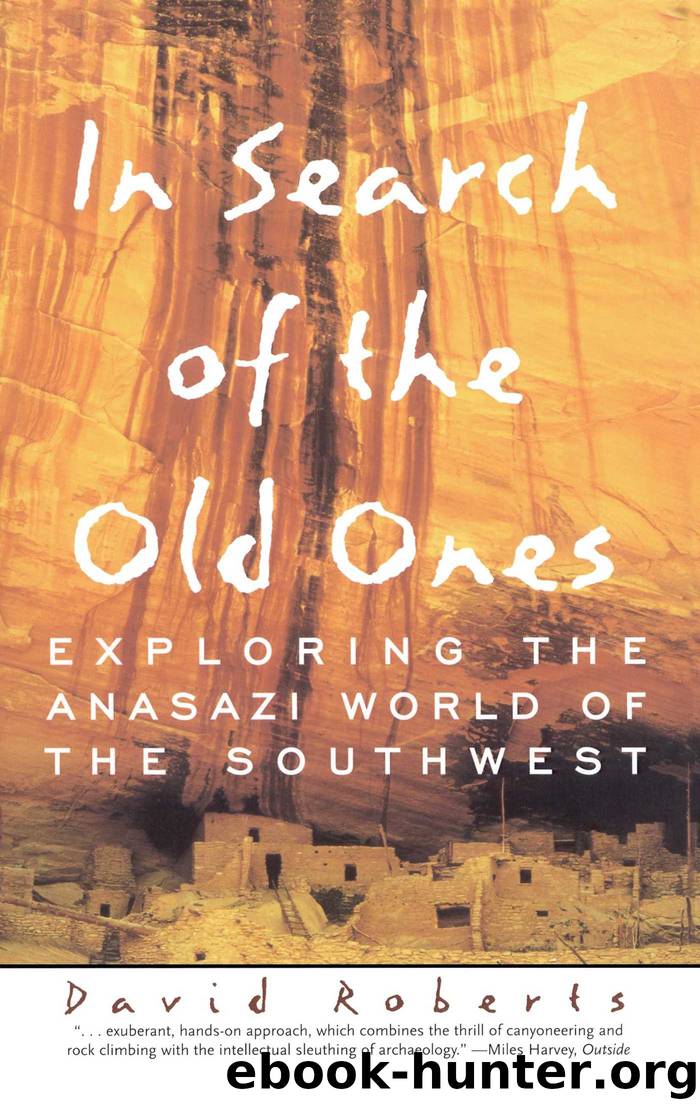
Author:David Roberts
Format: epub
Publisher: Simon & Schuster
Published: 1995-12-31T16:00:00+00:00
Finally, Cordell argues that the move into cliff dwellings in the thirteenth century could have had other motives than defense. With the wild game all but depleted, the Anasazi came to depend more than ever on their crops. Every square foot of cultivable soil was precious: caves offered building sites at no expense of arable soil. If the Anasazi, pushed to the limit, planted on both mesa top and canyon bottom, cliff dwellings, halfway between the two, minimized the time spent walking to fields and the labor of hauling home grain. And if, in the desperation of the diminished yields of the thirteenth century, the Anasazi pulled out all their agricultural stops—check dams, terraces, hand-watering—they had little time left over to build their villages. A house protected by an overhang can be more carelessly and quickly erected than one that must withstand the rains and winds out in the open.
Cordell’s is a compelling argument, and no expert on the other side of the fence has yet been able to dissolve her objections. But within the last five years, there is an unmistakable trend in Southwestern research to grant raiding and even warfare a larger role in Anasazi life than they had previously been seen to play.
During three days in October 1994, I got a vivid hands-on demonstration of another answer to “What happened in 1250?”—an answer diametrically opposed to Cordell’s. My tutors were Jonathan Haas, of Chicago’s Field Museum, and his wife, Winifred Creamer, who teaches at Northern Illinois University. To make their point, Haas and Creamer led me up a nine-hundred-foot flatiron—a tilted slab of red sandstone—above the Kayenta Valley in north-eastern Arizona.
As we approached the base of the great rock, nicknamed Happy Valley, Creamer pointed out potsherds strewn here and there, naming the styles: “Sosi black-on-white, Dogozhi black-and-white, Flagstaff black-on-white. All three are typical of the early thirteenth century. Remember those patterns.” Thanks to the work of Jeffrey Dean and others, Kayenta ceramic styles have been dated with greater accuracy than the styles of perhaps any other part of the Anasazi domain. A sherd can date a ruin within twenty years.
We started our ascent, scrambling up soft earth, then spidering flat-footed on the tilted stone. At one point the only way to continue was to traverse left in shallow toeholds carved by the ancients. As we climbed higher, new scatterings of potsherds appeared underfoot. Even to my eye, these were clearly different from the ones we had found at the base. Creamer picked up a sherd with heavy black parallelograms and a cross-hatched pattern of black lines on a white slip. “Kayenta black-on-white,” she said. “You only get it after 1250.” She bent and picked up a pair of colored sherds, one black-on-red with white lines, the other red-on-orange. “Keet Seel polychrome,” said Creamer, “and Tusayan polychrome. Both also only after 1250.”
As we gained height, the barren valley stretching east of us took on coherence and shape. Buttes and pinnacles stood out, vividly limned by the afternoon sun. “Look how close we are to the road,” Haas commented, pointing at a few autos trundling along U.
Download
This site does not store any files on its server. We only index and link to content provided by other sites. Please contact the content providers to delete copyright contents if any and email us, we'll remove relevant links or contents immediately.
| Anthropology | Archaeology |
| Philosophy | Politics & Government |
| Social Sciences | Sociology |
| Women's Studies |
Cecilia; Or, Memoirs of an Heiress — Volume 1 by Fanny Burney(32558)
The Great Music City by Andrea Baker(32018)
Cecilia; Or, Memoirs of an Heiress — Volume 2 by Fanny Burney(31956)
Cecilia; Or, Memoirs of an Heiress — Volume 3 by Fanny Burney(31941)
We're Going to Need More Wine by Gabrielle Union(19046)
All the Missing Girls by Megan Miranda(16026)
Pimp by Iceberg Slim(14506)
For the Love of Europe by Rick Steves(14121)
Bombshells: Glamour Girls of a Lifetime by Sullivan Steve(14073)
Talking to Strangers by Malcolm Gladwell(13370)
Norse Mythology by Gaiman Neil(13363)
Fifty Shades Freed by E L James(13239)
Mindhunter: Inside the FBI's Elite Serial Crime Unit by John E. Douglas & Mark Olshaker(9341)
Crazy Rich Asians by Kevin Kwan(9291)
The Lost Art of Listening by Michael P. Nichols(7506)
Enlightenment Now: The Case for Reason, Science, Humanism, and Progress by Steven Pinker(7313)
The Four Agreements by Don Miguel Ruiz(6765)
Bad Blood by John Carreyrou(6621)
Weapons of Math Destruction by Cathy O'Neil(6279)
